






The Amazon is losing forest at an alarming pace, and the public broadly supports action to bring deforestation under control. Governments across the basin have deployed different regulatory approaches to rein in destruction linked to expansion of the agricultural frontier. Sectoral interests have repeatedly blocked or hollowed out these efforts, while advocates of sustainable development continue to push for legal action against land grabbing and illegal deforestation. Despite setbacks, Brazil has made significant strides in addressing this complex challenge, demonstrating that meaningful reductions are achievable when a clear regulatory framework is paired with the political will to enforce it, particularly when reinforced by market-based incentives that shape producer behavior.
At the center of the Brazilian system is the Código Florestal, a landmark statute that establishes explicit, biome-specific conservation thresholds, a public georeferenced registry, and—crucially—an obligation to restore forest cleared in excess of those thresholds. Bolivia has taken a different approach. It has a relatively coherent forest law, but its land-use regulatory framework is embedded within its land tenure and titling process. Many analysts believe the Bolivian system has accelerated deforestation rather than restrained it, and that Bolivian policymakers should examine what has worked in Brazil, not to copy it, but to adopt those elements that make sense for Bolivia.
The Brazilian Forest Code: Obligations, Restoration, and Enforcement
Brazil’s Código Florestal assigns every rural property a legally defined obligation to maintain native vegetation. The Reserva Legal mandates a specified percentage remain permanently forested: 80% in the Amazon biome, 35% in Cerrado portions of the Legal Amazon, and 20% elsewhere. Áreas de Preservação Permanente (APPs) protect watercourses and steep hillsides for their role in provisioning ecosystem services. The modern Code dates to 1965; its 2012 reform established the Cadastro Ambiental Rural (CAR), an online georeferenced registry that maps every holding’s vegetation cover against its legal obligations and transforms compliance into a spatially explicit, publicly auditable record.
Equally important is the restoration obligation. A landowner whose property has been cleared beyond the legal limit carries a “forest debt.” The shortfall must be restored through native regeneration, replanting, or compensation via environmental reserve offsets (CRAs) purchased from landowners with surplus forest. Restoration is not optional, but Brazilian law recognizes agroforestry systems using native species as a valid compliance pathway, reconciling productive use with forest recovery. The 2012 reform modified the obligation through an amnesty for pre-2008 clearing and lenient treatment of small holders, but the principle survived: conversion beyond the legal threshold creates a debt the landowner must repay.
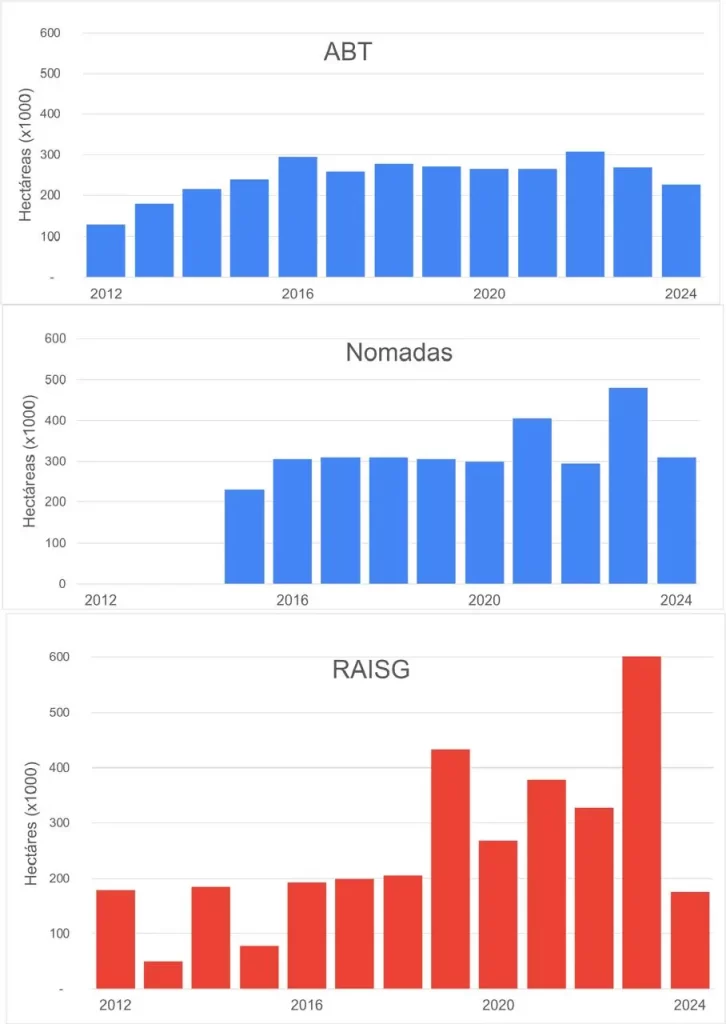
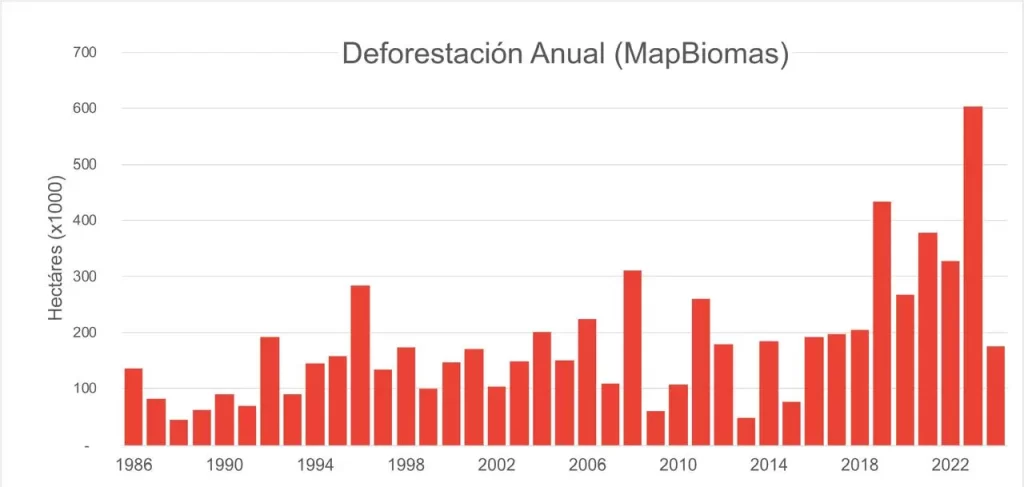
Brazil’s recent history demonstrates what this architecture can and cannot do. Under Bolsonaro, annual Amazon deforestation surged to roughly double the prior decade’s average, peaking at 13,000 km² in 2021. Bolsonaro did not rewrite the Forest Code; he dismantled enforcement, defunded IBAMA and made it clear that illegal clearing would not be prosecuted. The same architecture that had delivered historic reductions between 2004 and 2012 produced unacceptable forest loss in the early 2020s. Under Lula, Environment Minister Marina Silva rebuilt IBAMA, unblocked the Amazon Fund, and restored the enforcement posture. By 2025, Amazon deforestation had fallen below 6,000 km²—the third-lowest rate since satellite monitoring began in 1988 and a 50 percent reduction from 2022. No new conservation law produced this result. What changed was the political will to enforce the one already in place.
Bolivia: The Anatomy of a Captured Regulatory System
Bolivia is not a regulatory vacuum. The 2009 Constitution enshrines environmental rights, elaborated in the 2010 Ley de Derechos de la Madre Tierra; the Ley Forestal establishes the principle of protecting forests that provide ecosystem services on private properties; and the Ley INRA governs land tenure, with land-use compliance functioning as a test of ownership. The two statutes operate together through regulatory provisions and a layered set of land-use planning instruments (PLUS, PMOT, POP) that, in principle, regulate whether landholders may clear native forest. It is a dense, complex framework designed by consultants on the premise of a technocratic meritocracy that never materialized. The problem is twofold: the tenure law creates an incentive to clear, and provides an instrument that legalizes the clearing.
The plan de ordenamiento predial (POP) is a property-level plan that classifies each parcel of a landholding by permitted use and authorizes conversion of native vegetation on parcels designated for agriculture or pasture. In a functional system, a POP would empower landowners to integrate productivity and conservation—matching crops to soils, respecting slope and hydrology, preserving biologically valuable corridors, and securing a legal basis for long-term investment. In Bolivia, it has become an instrument of destruction and extortion: an opaque, captured procedure that serves neither ecology nor productivity, but the rent-seeking incentives of consultants, functionaries, and operators, who are aligned with landowners seeking to convert land assets into financial capital through forest clearing.
The dysfunction is structural. POPs are drafted by private consultants paid by the landowner whose property is being classified, with the consultant’s continued employment contingent on delivering a plan the client finds acceptable. Soil capability classes that should restrict conversion are routinely upgraded; riparian buffers are narrowed or omitted; standing forest is reclassified as agricultural use. The Autoridad de Fiscalización y Control Social de Bosques y Tierra (ABT), which approves POPs and issues deforestation authorizations, is beholden to the economic power of agribusiness and the political influence of migrant settlers seeking access to public lands. Procedural complexity that should guarantee rigor instead generates opportunities for extraction. Complexity is the ecosystem in which extortion thrives.
The dysfunction runs one level deeper. Under Ley INRA, every landholder must demonstrate the Función Económico-Social (FES) of the property to avoid full or partial reversion to the state. In principle, FES is a flexible concept: sustainable forest management, Indigenous customary use, and conservation can all qualify. In practice, however, FES verification has defined productive use as visible clearing, fencing, and cultivation, while intact forest is treated as unproductive and, therefore, vulnerable to reversion. The POP functions not merely as a permit to clear but as the instrument by which a landholder demonstrates FES and secures title against reversion. A system ostensibly designed to regulate conversion has been turned, by the logic of Bolivia’s own tenure-compliance rules, into an engine of destruction.
The result is that a landowner seeking to clear forest in Bolivia does not need to evade the law. The law provides a procedure that converts ecological destruction into bureaucratic legitimacy, while taxing conservation-minded operators through opaque delays, informal payments, and the threat of dispossession. Periodic decrees and regularization programs add a further layer of absolution, retroactively authorizing clearing that was never properly permitted. The framework does not merely fail to prevent conversion; it formalizes it, rewards those who complete it, and extracts rents from everyone passing through. The whole system is rotten to the core.
An Encumbered Inheritance
Critics of land-use regulation frame conservation requirements as an imposition on property rights. In the Bolivian lowlands, this framing inverts the actual history. Most large private holdings in Santa Cruz, Beni, and Pando originated not in the settlement of vacant land but in paper titles distributed during the military dictatorship of the 1970s, when grants were issued to officers, business cronies, and well-connected families. Most were never surveyed, occupied, or cultivated; they sat dormant for decades as speculative assets or loan collateral. Actual execution—the clearing, fencing, and conversion that turned paper into properties—came only in the 1990s and 2000s, when soy expansion, infrastructure investment, and land-titling programs created the incentive to invest capital and clear forest.
The land the state claimed to be distributing was not empty. Indigenous communities (Chiquitano, Guarayo, Ayoreo, Moxeño, Baure, Tacana, Chacobo, and others) had occupied these territories for generations, and their status as public lands rested on a legal fiction imposed by a state that ignored their ancestral claims. The 1990 Marcha por el Territorio y la Dignidad was a direct response to this dispossession, but the subsequent creation of Indigenous territories (TCOs) was an incomplete correction. In Chiquitania, communal landholdings trace to the 1960s, when latifundistas, under belated pressure from the 1953 agrarian reform, ceded a small fraction of their massive estates to the Indigenous workers who had long labored on those estates in an arrangement that amounted to serfdom.
Most private holdings in the Bolivian lowlands therefore carry not one encumbrance but two: the general public-patrimony encumbrance that Bolivia’s constitutional tradition attaches to subsoil resources, water, and forest, and a specific historical encumbrance born of Indigenous dispossession embedded in their titles. Clearer conservation obligations do not impose a new burden; they make explicit obligations always part of the bargain. Brazil’s Supreme Court upheld the reformed Código Florestal in 2018 on a related principle, affirming the Reserva Legal as an expression of the social function of property—a doctrine embedded in the Brazilian Constitution since1934 and the Bolivian Constitution since 1938.
The Reform Agenda
The reforms follow directly from the diagnosis. First, clear property-level conservation obligations differentiated by biome: higher thresholds in the humid Amazon, intermediate in the Chiquitano dry forest, lower in savanna biomes—each quantified and non-negotiable. Second, a restoration obligation on lands cleared beyond the legal threshold, with agroforestry using native species recognized as a valid compliance pathway. Third, a publicly accessible georeferenced registry layering current vegetation cover over titled holdings, making every property’s compliance status visible to regulators, commodity traders, and civil society. Fourth, FES verification must be reformed so that intact forest, sustainable forest management, and restored land count as fulfilling the social-economic function of property, as the Constitution and existing statutes already permit. Fifth, and most importantly, the POP system must be radically simplified: fewer categories, clearer decision rules and standardized templates, with compliance monitored by an AI-assisted review drawing on open geospatial data, so that scarce enforcement attention is directed where discrepancies are largest, while eliminating the opportunities for graft.
Thresholds and registries are not remedies in themselves. Brazil under Bolsonaro shows that explicit rules on paper are useless when enforcement is disabled. What these instruments contribute—with a reformed POP and a credible restoration requirement—is the evidentiary basis for enforcement, prosecution, and commodity-market due diligence. Satellite monitoring is a force multiplier for competent enforcement and an expensive ornament without it. Pressure from the major consumer markets is converging on this point: the EU’s Deforestation Regulation demands georeferenced due diligence on soy, beef, palm oil, cacao and timber; the United States applies the Lacey Act to illegally harvested wood products and is moving to extend analogous requirements to agricultural commodities; even China is advancing a Green Supply Chain initiative and stronger expectations of legal sourcing. The shared message from Brussels, Washington, and Beijing is that commodities entering global markets must be produced through legal means. Regulatory reform can give compliant producers access to the markets that pay the highest price.
A Political Window—and Its Limits
Bolivia’s new political landscape may create an opening. President Rodrigo Paz, inaugurated in November 2025, campaigned on cracking down on illegal land clearing and regulating agricultural burning, an acknowledgment that the environmental crisis in Bolivia’s lowlands has become a mainstream political liability. His platform also centers on market integration and restoring Bolivia’s international credibility. A reformed POP system, conservation and restoration obligations, and a georeferenced public registry could serve both commitments. But Brazil is a warning: four years of dismantlement under Bolsonaro undid a decade of enforcement gains. Reforms must be designed to survive changes of government—embedded in institutions, not in decrees that a future minister can quietly reverse.
Now Is the Time to Act
Bolivia is at an inflection point. Accelerating deforestation across Beni, Santa Cruz, Pando, and La Paz is incompatible with the country’s constitutional commitments, its obligations under the Paris Agreement and the Kunming-Montreal Biodiversity Framework, and the long-term interests of an agricultural sector that depends on intact forest hydrology. The problem is not an absence of rules. It is a captured land-use planning system and an enforcement apparatus that lacks the political support required for the task.
Brazil’s Código Florestal embodies a principle Bolivia should internalize on its own terms: every private landholding should contribute to the conservation of native ecosystems through obligations that are quantified, georeferenced, publicly registered, enforceable, and—where debts exist—restorable. The legal foundation already exists in Bolivian land tenure history; these are not new impositions but the explicit recognition of encumbrances always embedded in how these lands passed from public to private ownership. Brazil’s experience under Bolsonaro and Marina Silva demonstrates that architecture matters, but enforcement matters more.
The lesson for Bolivia is clear. Explicit, georeferenced obligations combined with a binding restoration requirement create the conditions under which enforcement, prosecution, and supply-chain due diligence can be exercised. Bolivia should draw from Brazil’s design, learn from its recent history, and undertake the rebuilding of its own POP system. But design alone will not save the forest. A truly functional system must enjoy the broad support of Bolivian society, which means it should be designed by Bolivians, negotiated by Bolivians, and — above all — enforced by Bolivians. Otherwise, it will be just another “saludo a la bandera”.
***